Word Count: 5324
List of Figures:
Figure 1: Sketch Designs (Oliver Lund, 2025)
Figure 2: Poster Designs (Oliver Lund, 2025)
Figure 3: Notebook Designs (Oliver Lund, 2025)
Figure 4: Social Media Posts (Oliver Lund, 2025)
Figure 5: Background Designs (Oliver Lund, 2025)
Figure 6: Addy the Lion (AGC Museum mascot) (AGC Museum, 2025)
Figure 7: Placement Timeline (Oliver Lund, 2025)
Figure 8: AGC Museum Outlook Email (Outlook, 2025)
List of programmes used:
Photoshop
Canva
Figma
ChatGPT
Facebook Meta Suite
Introduction
As required for my Digital Media course, I undertook a placement at the AGC Museum. I selected this company because of my interest in marketing and social media. I was also fascinated by the opportunity to gain experience doing design work for a company. During my placement, I helped with their marketing and promoted their events, with a strong focus on social media and design.
A key aspect of my role in this industry was analysing their social media analytics using the Facebook Meta Suite to identify which posts performed well and which did not. I analysed specific parts, such as how many likes, comments, and shares Instagram and Facebook posts had received. I then wrote an essay explaining why I believed their posts had done well and not done well, and what aspects could be changed to improve them further. In addition, I helped the museum by designing notebook covers for sale, thereby supporting the brand. All tasks completed were part of the learning agreement for my placement.
My decision to undertake a placement at the AGC Museum was influenced by my interest in volunteering with a company such as this and in developing key skills that could help me in the future. The AGC Museum made it clear they were interested in new volunteers, especially for their marketing, and this was an excellent opportunity for me to further develop my design skills.
Museums are a competitive industry trying to attract more visitors to see their artefacts, and to attract customers, they have to rely on effective marketing strategies that grab the audience's attention. Kotler et al. (2008) argue that museums must move beyond traditional advertising and more towards design marketing to communicate with audiences, further advertise the brand and its identity, and showcase what they have to offer, helping motivate people to see what the museum has to offer. This is all relevant in modern-day museum practices as they start to use social media to promote themselves. Social media plays a vital role in driving audience engagement, as many people use it. This work highlights the importance of audience engagement and discusses the different audience demographics, the communication used for each, and how these factors influence marketing and design decisions.
Further understanding what the experience was like for visitors was essential to the design of the promotional material. Falk and Dierking (2016) further proposed how museum experiences are shaped through personal and social context. This suggests that marketing materials, such as posters and social media, should align with the emotional and educational experiences people have when visiting museums. Advertising the museum's clear themes and visual identities can better prepare the audience for the experience they are about to have. Black (2012) supports this view. The article states that the museum must develop an audience-centred approach to stay relevant as visitors increasingly use technology.
Brand identity plays a significant role in how museums present themselves to their audiences through social media. Keller (2012) says that strong brands rely on elements recognisable to their audience to help create an emotional connection with them. One of those strategies is the use of mascots and character branding, which can help the museum feel more relatable to the audience and more approachable, particularly for children. The use of a mascot such as Addy the Lion further aligns with Keller's (2012) theory of brand recognition, as it provides a constant, recognisable visual cue for audiences to associate with and relate to the museum. This can also be understood further through Karvaratzis and Hatch's (2013) argument that organisations such as museums further develop their brand identity through constant visual communication, values, and audience engagement rather than through isolated marketing assets.
Brand identity plays a key role in the way the museum presents itself. Kotler et al (2008) state that effective museum marketing requires a thorough understanding of the communication platforms to reach different audience groups. This is very relevant when comparing the two social media platforms used by the AGC Museum: Facebook and Instagram. These are very different and typically attract very different audiences: Instagram is typically for the younger generation, whilst Facebook is for the older generation. The research on the museum's social media made it clear that people who use Facebook are typically more interested in story-based posts with a lot of writing, whilst younger audience members respond better to posts that are more eye-catching and visually appealing. These findings are critical to the designs as they help align with what the audiences expect to see.
Sustainability is a significant consideration in museum practices. The United Nations Sustainable Development Goals, particularly SDG 12 (Sustainable consumption and Production) and SDG 8 (Decent work and economic growth), helped provide an understanding of what sustainable practices belong in an institution such as the AGC Museum that would be considered sustainable tourism (United Nations, 2023). Museums often face a moral dilemma between environmental responsibility and operational necessity, such as maintaining the wax figures and keeping the air well ventilated to provide visitors with comfort, which consumes a lot of energy. However, adopting a digital-first approach and reducing material waste help align with supporting economic and environmental growth, which fits with SDG 12 and SDG 8.
Overall, this literature review highlights the importance of audience-centred design, strong brand engagement, digital engagement, and sustainability in the museum market. These concepts help provide an idea of how analysing the designs and marketing work can yield practical ideas to make the museum more sustainable, more accessible, and more appealing to its audience.
The work during my placement was carried out in several steps. These steps helped me learn how to improve my work further and make it better for the AGC Museum. The work began as sketches and evolved into design iterations. This methodology combines design practices, secondary research, digital analytics review, and reflective evaluation. This was done to gain a better understanding of the work completed for the AGC Museum.
Sketching was done to help explore new ideas and to see where they could be taken further. It tested the visual ideas, characters, and colours to be used in the final designs. This was particularly evident when developing child-friendly designs. These sketches helped refine the overall designs and have made them what they are now as finished products.
A secondary methodology was used to review existing social media posts created with the Facebook Meta Suite. This helped provide insight into social media analytics and understanding of social media posts, likes, shares, and comments across both Facebook and Instagram. When comparing posts, patterns emerged, revealing what the audience liked and disliked, helping provide a clearer understanding of the audience as a whole.
During my placement, I had access to the business's Facebook Meta Suite, which allowed me to review engagement data for the company's social media posts on Facebook and Instagram. Although I no longer have access to the dashboard following the end of my placement. The recordings of patterns that were seen in the dashboard have been saved in my document labelled Instagram and Facebook document (See Appendix A), but the actual numbers themselves were not saved. Therefore, this evaluation is based more on the observed trends and the patterns seen than numerical data.
Analysis of the data revealed the difference in audience engagement across the two platforms. Facebook posts that focused on artefacts in the AGC Museum and gave long explanations detailing the artefacts appeared to generate higher levels of engagement than visually appealing posters on Instagram. At the time of reviewing, artefact-focused Facebook posts typically achieved a higher audience engagement than other posts visible on the dashboard. In contrast, Instagram posts had less audience engagement, even though they were more visually appealing.
This suggests that the museum's older and biggest supporters preferred informative, story-driven Facebook posts over purely promotional visuals. This information helped with later design work by giving me an understanding of what one demographic wanted to see in social media posts and what the other demographic wanted to see.
The Digital Analytics review was focused on posts from the last year (2025); posts from Facebook and Instagram were analysed using the Facebook Meta Suite dashboard. Interactions on the posts, such as likes, comments, and shares, and the overall reach of the posts were prioritised to help identify patterns in the posts' analytics. Posts were compared by content type and platform, and the observations were later recorded in a document labelled "Instagram and Facebook" for the AGC Museum to see. (See Appendix A)
Secondary research on this placement and its work helped provide a greater understanding of the overall marketing for the AGC Museum, including why they chose a mascot and how they segment their audience. Sources such as Kotler et al (2008) were used to guide the creation of designs for a particular audience demographic. This approach further aligns with Cargo and Cargo's (2001) discussion of nonprofit organisational leadership, which highlights the importance of planning, communication, and management in organisations such as the AGC Museum.
Sustainability was embedded in the work, as it was all done digitally rather than on paper, which helped reduce unnecessary product use and supported the environmental practices set by SDG 12. Some assets were reused multiple times, such as backgrounds, to reduce the need to create new content each time and to avoid unnecessary energy use.
The use of AI was very limited overall and would not be used without the museum's permission. AI was only permitted once, as this helped stop its overuse and generate more original ideas.
Reflective practices informed the methodology, as ongoing reflection helped me understand the design decisions, audience sustainability, communication with stakeholders, and the limitations encountered during my placement. Feedback from the AGC Museum staff helped inform the placement's outcomes, including design choices.
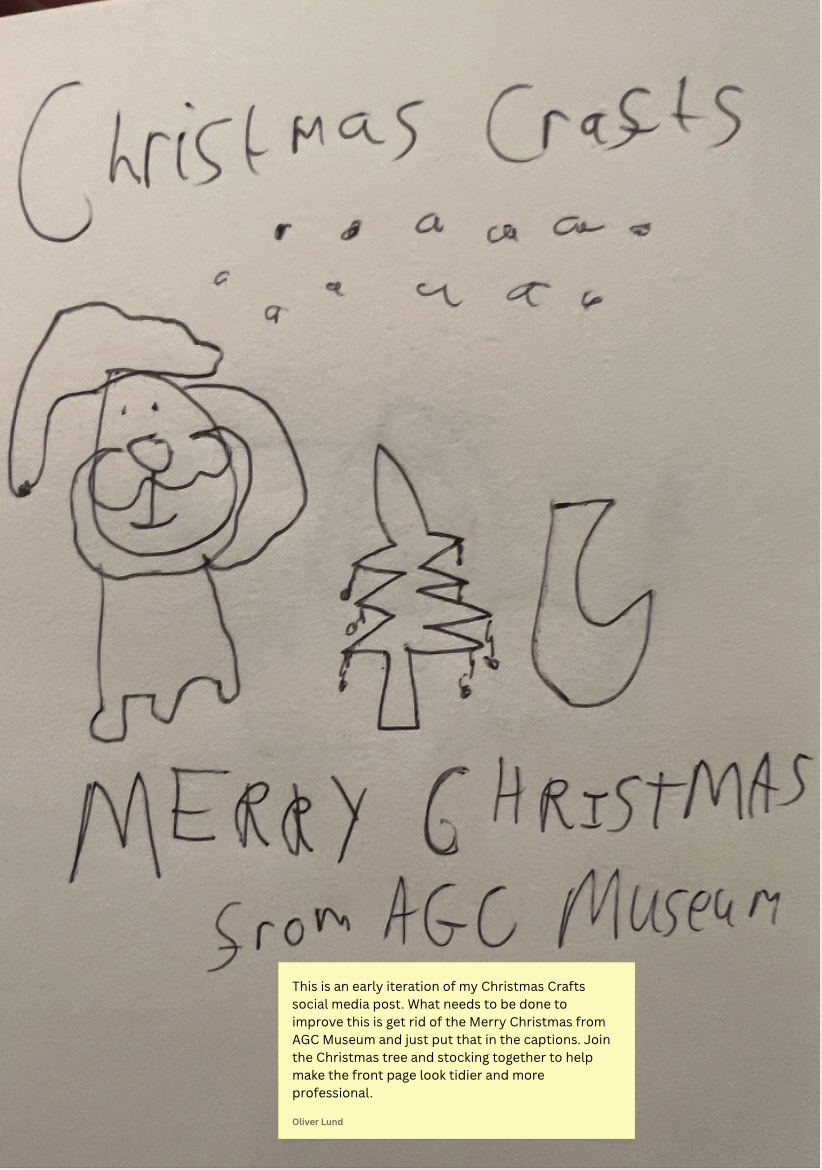
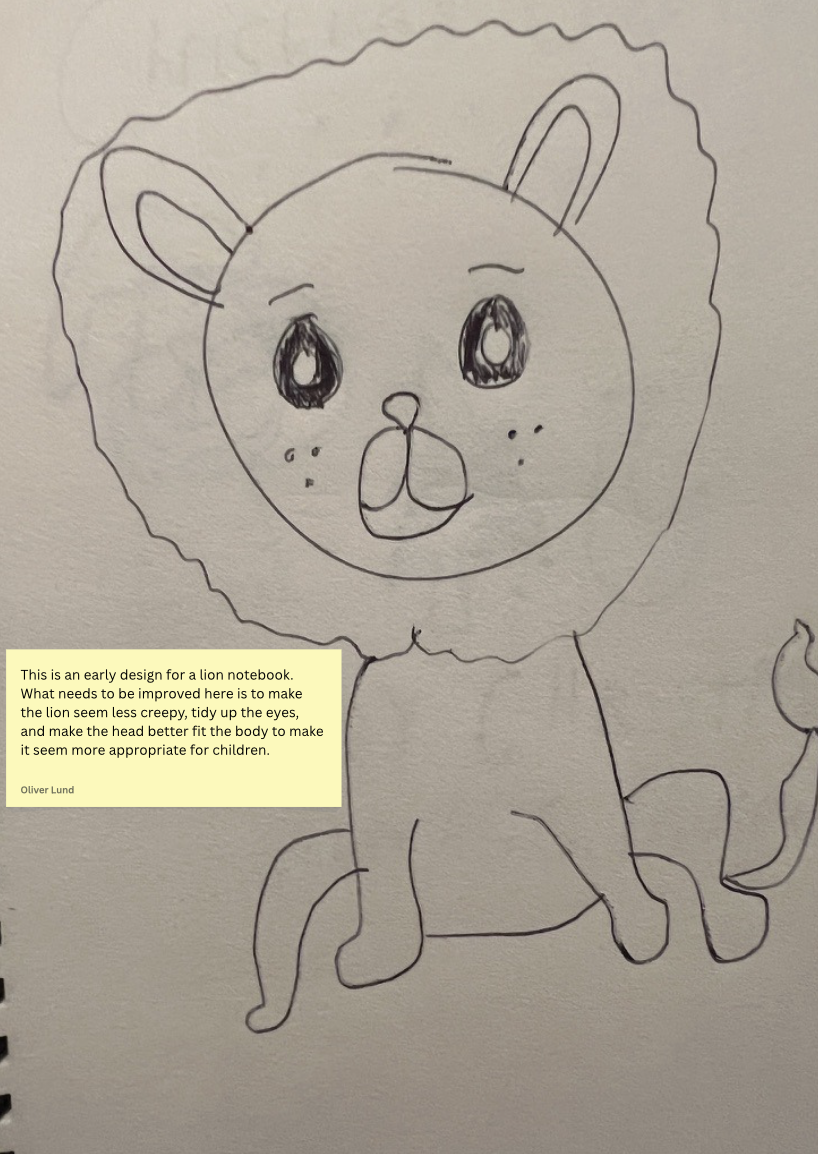
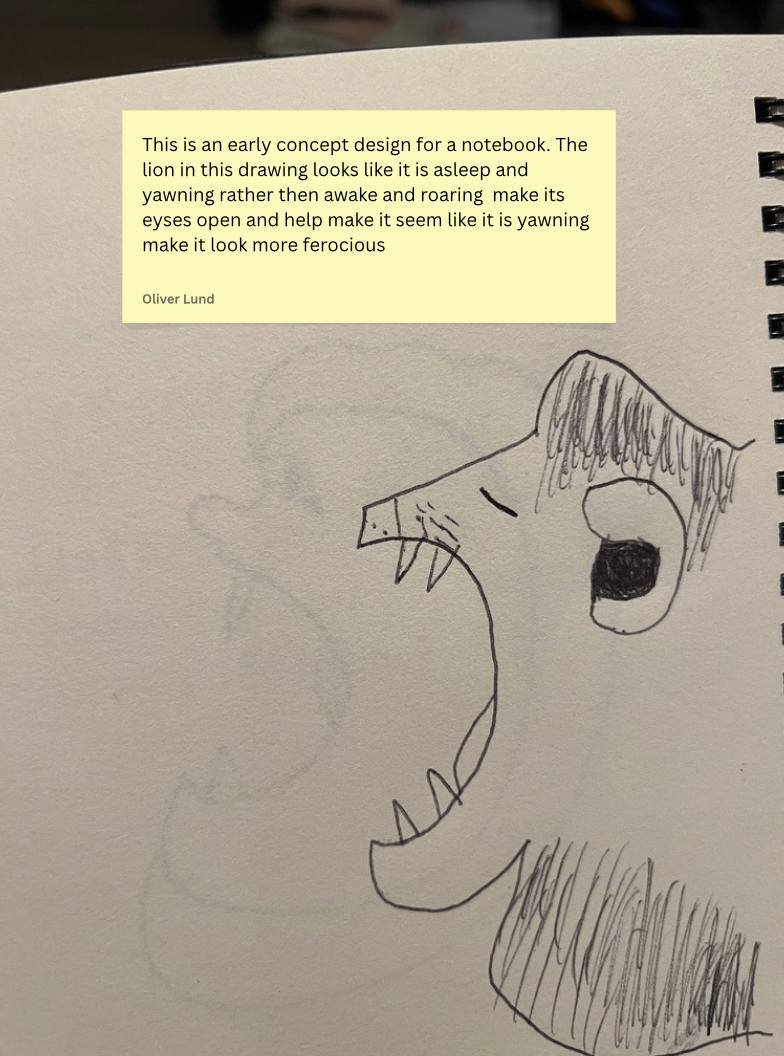
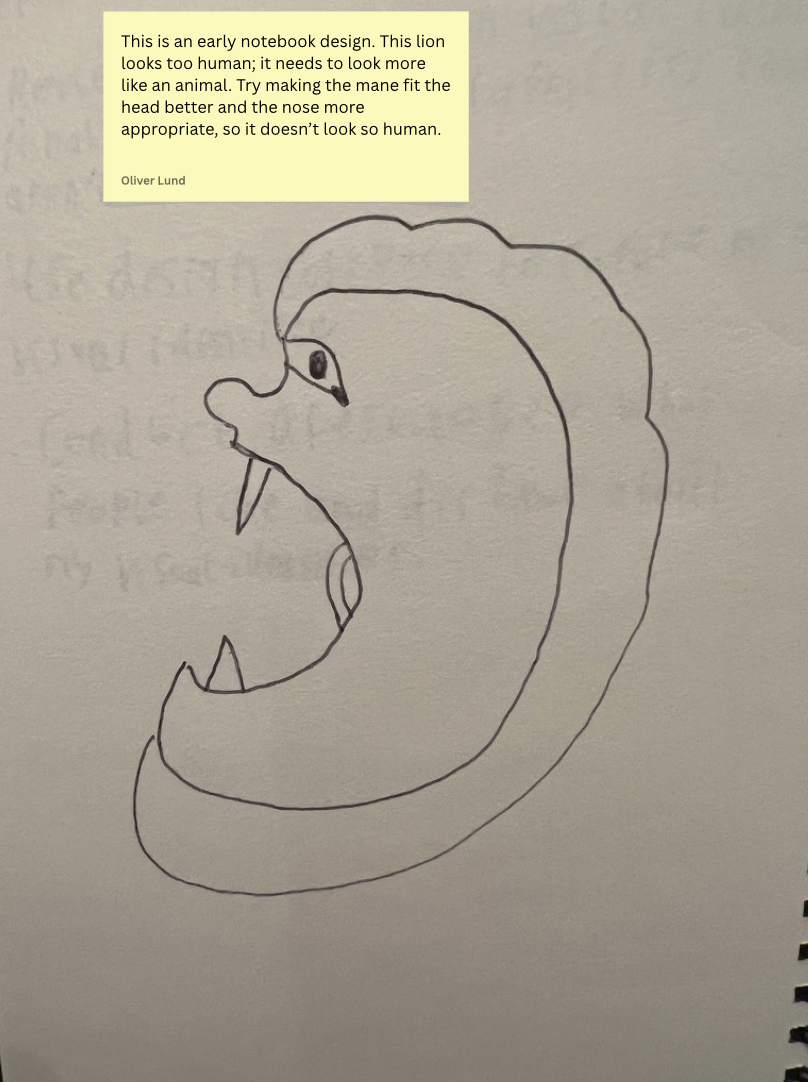
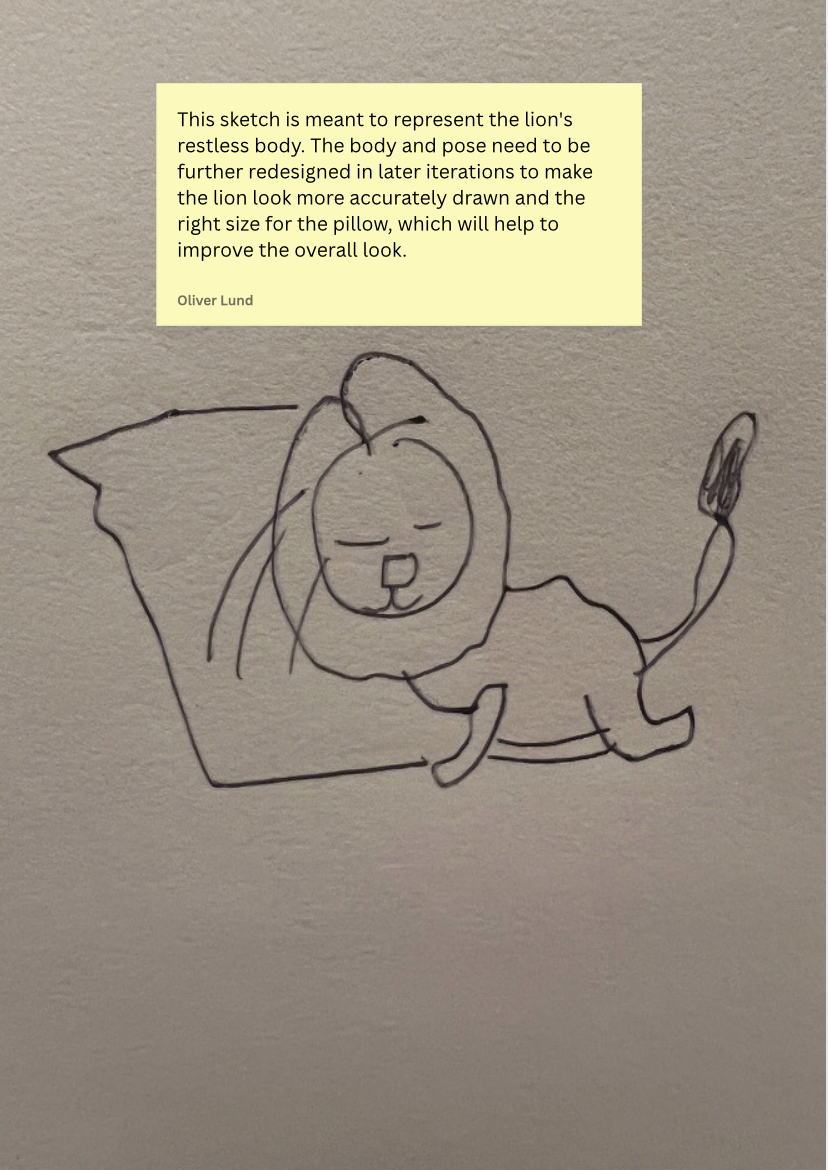
Figure 1: Sketch Design.
Source: Author’s own work (Oliver Lund, 2025).
Here are some early sketch designs from my work journal. These were ideas to help me establish a basis for how I wanted my final designs to look. These rough sketches served as inspiration. These sketches include notes to help me remember what needs to be done to improve them further. These sketches gave me a clearer understanding of what the AGC Museum was looking for in their notebook designs and social media posts.
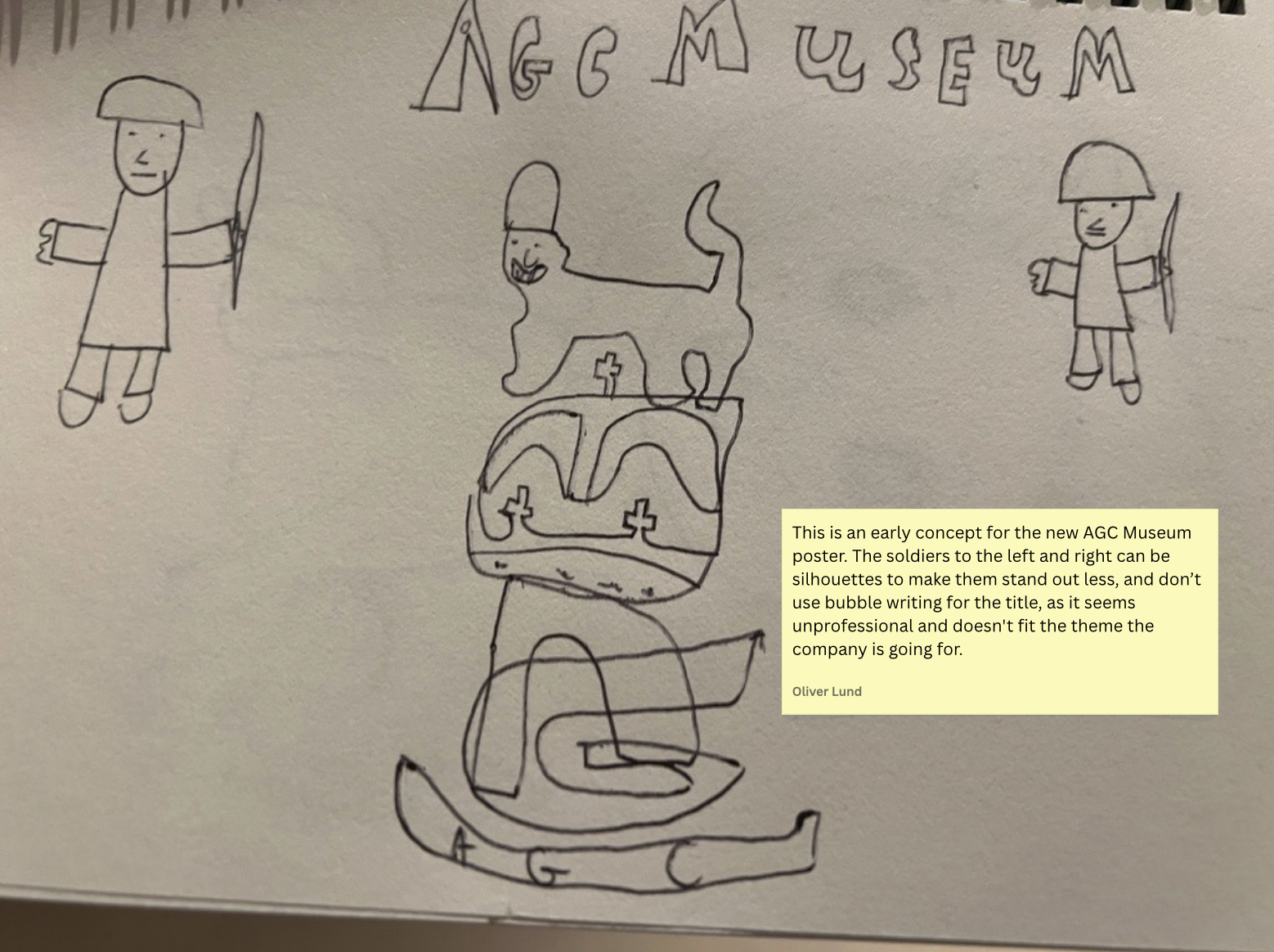
Figure 2: Poster Design.
Source: Author’s own work (Oliver Lund, 2025).
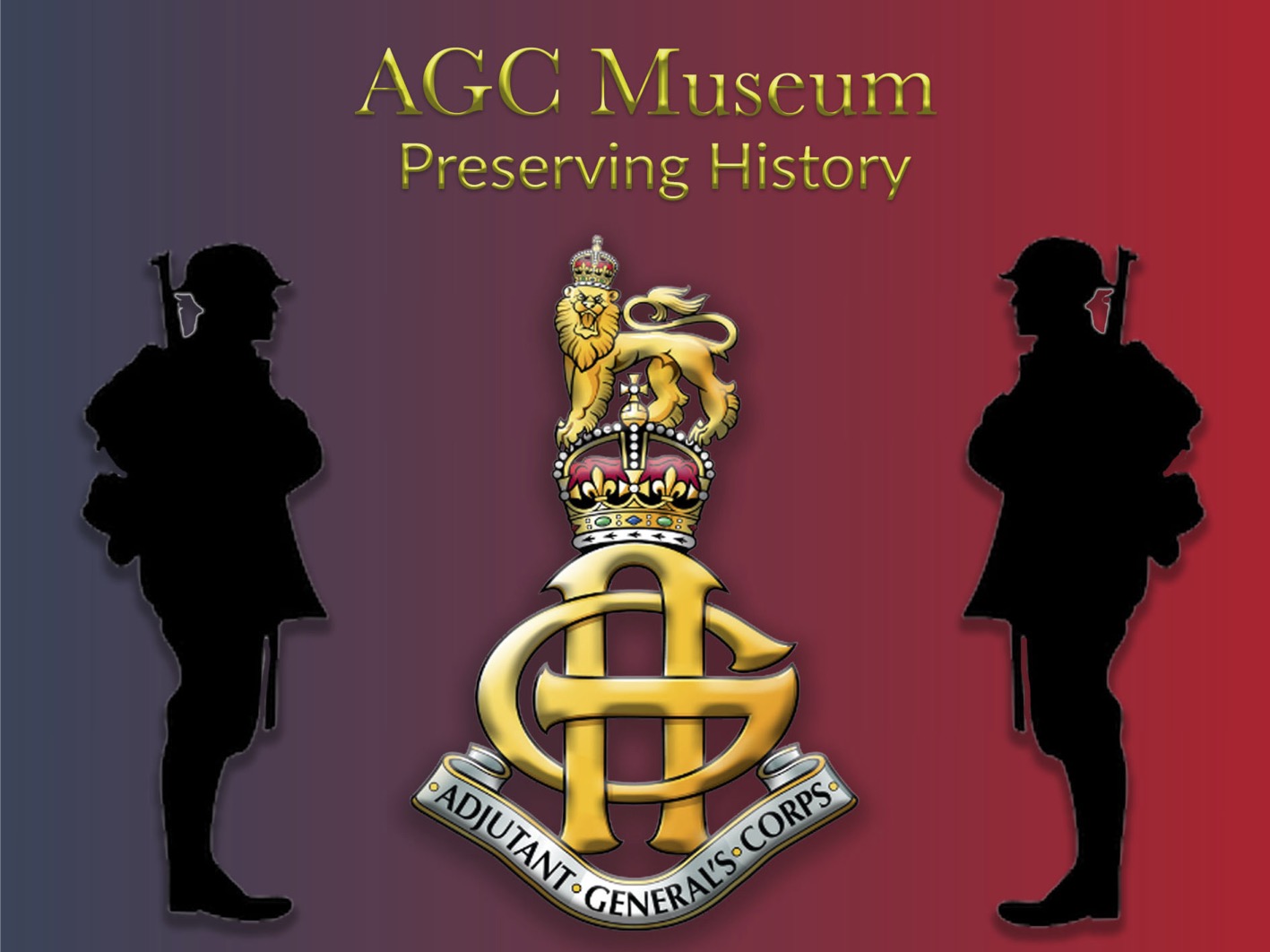
What you see above is a poster design I created for the AGC Museum. This was sketched on paper, which helped lay a foundation and gave me a clearer understanding of how I wanted my poster to look, as shown above. (Oliver Lund, 2025) The final design was done using Photoshop. The administrative and organisational history of the British Army inspired the theme of the poster. These design decisions were made to reflect the AGC Museum's collection, which primarily focuses on modern and historical military, and to be more appealing to the adult audience, who engage more with historically grounded and serious visual narratives, as identified through social media feedback.
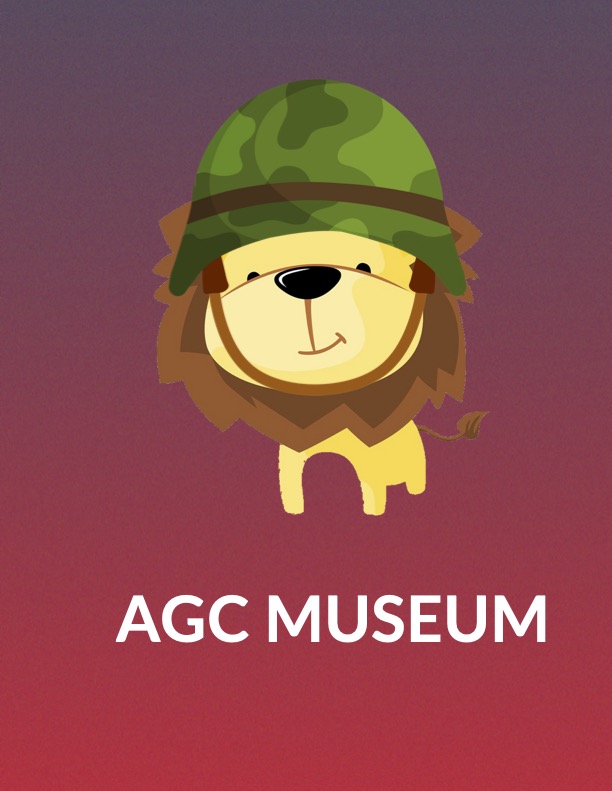
Figure 3: Notebook Designs.
Source: Author’s own work (Oliver Lund, 2025).
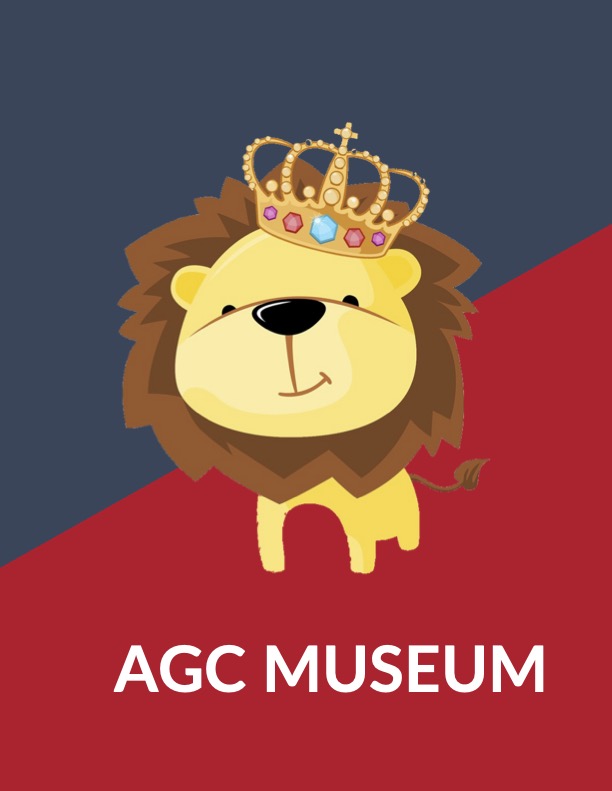
Here are some notebook designs I created for my placement. These designs were based on the AGC Museum's mascot, Addy the Lion. Addy the Lion was previously used in the museum's advertisements, appearing on posters and social media. Due to Addy the Lion's rising popularity, the AGC Museum wanted to feature him on the covers of their new notebooks. Although they liked their current mascot, they asked for a new variation of Addy the Lion, one that would still be friendly for children to see but also unique in its own way. I designed these notebooks this way because I wanted the Lion on the front cover to be the key selling point.
I chose Canva for this work because of its ease of use, and, as the company told me, because it was the design tool they wanted me to use for creating their new notebook covers. Canva was also a software I was familiar with, having used it in the past.
This work was quite a challenge, as coming up with an original design for the AGC Museum's mascot proved difficult. What I did to help come up with new designs for the mascot was look at images of Lions for reference, and I tried to find a way to make them seem more child-friendly and cartoon-like, as that is a style most children typically enjoy.
This was such an important role because these designs would be a key part of the AGC Museum's selling point, especially with children. Not having done much work targeted at children, this was a completely new experience, and it helped me learn how to create designs that appeal to a younger audience.
All these designs were created online rather than printed to reduce paper waste, in accordance with SDG 12. It was more practical for my work to produce multiple designs of these notebooks online rather than creating them on paper and potentially wasting paper by discarding failed designs. This is my way of incorporating SDG 12 into my notebook designs. (The Global Goals, 2025)
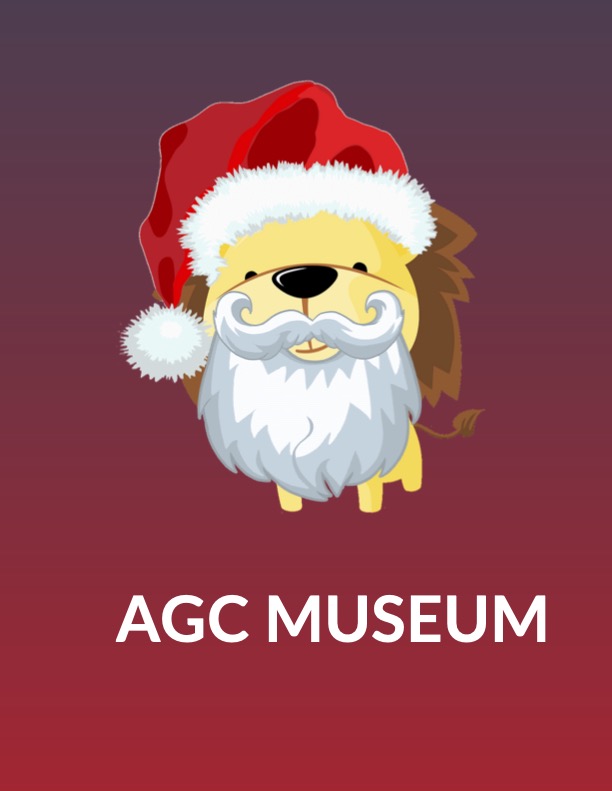
Figure 4: Social Media Posts.
Source: Author’s own work (Oliver Lund, 2025).
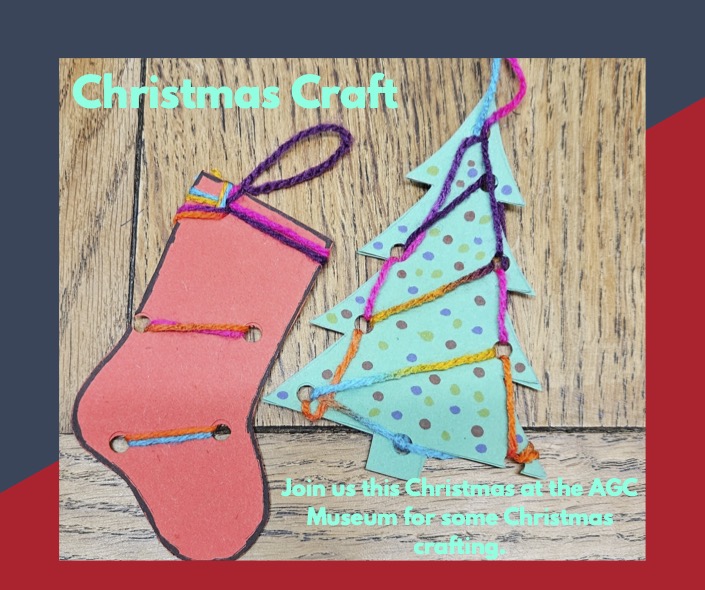
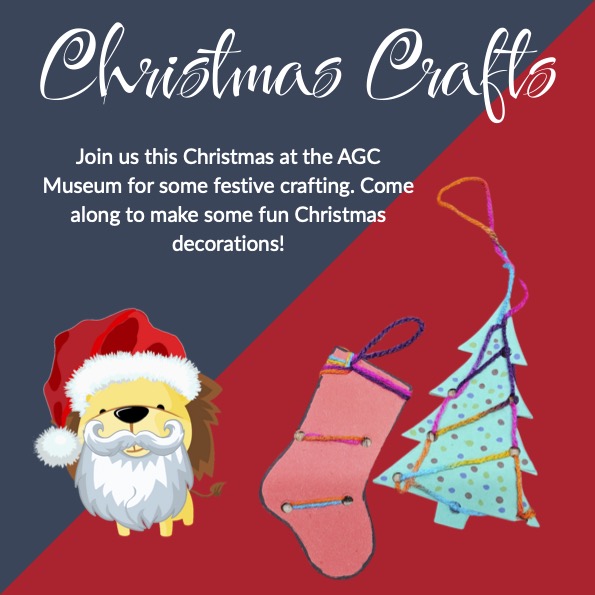
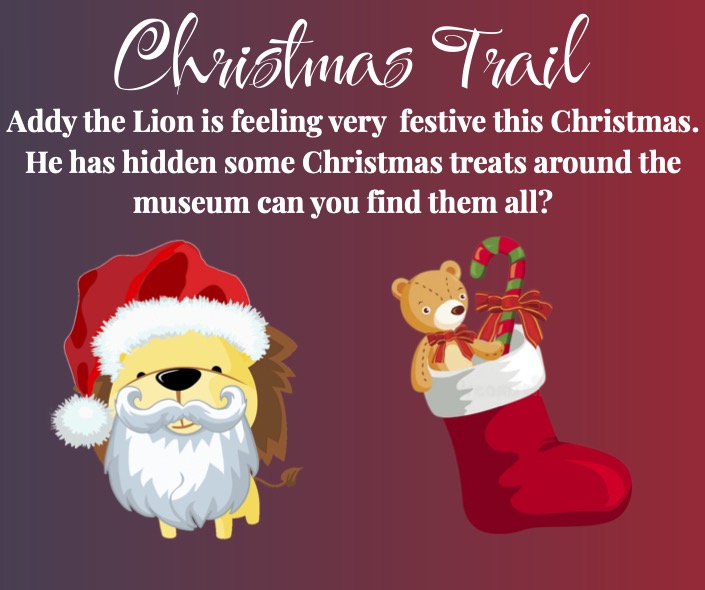
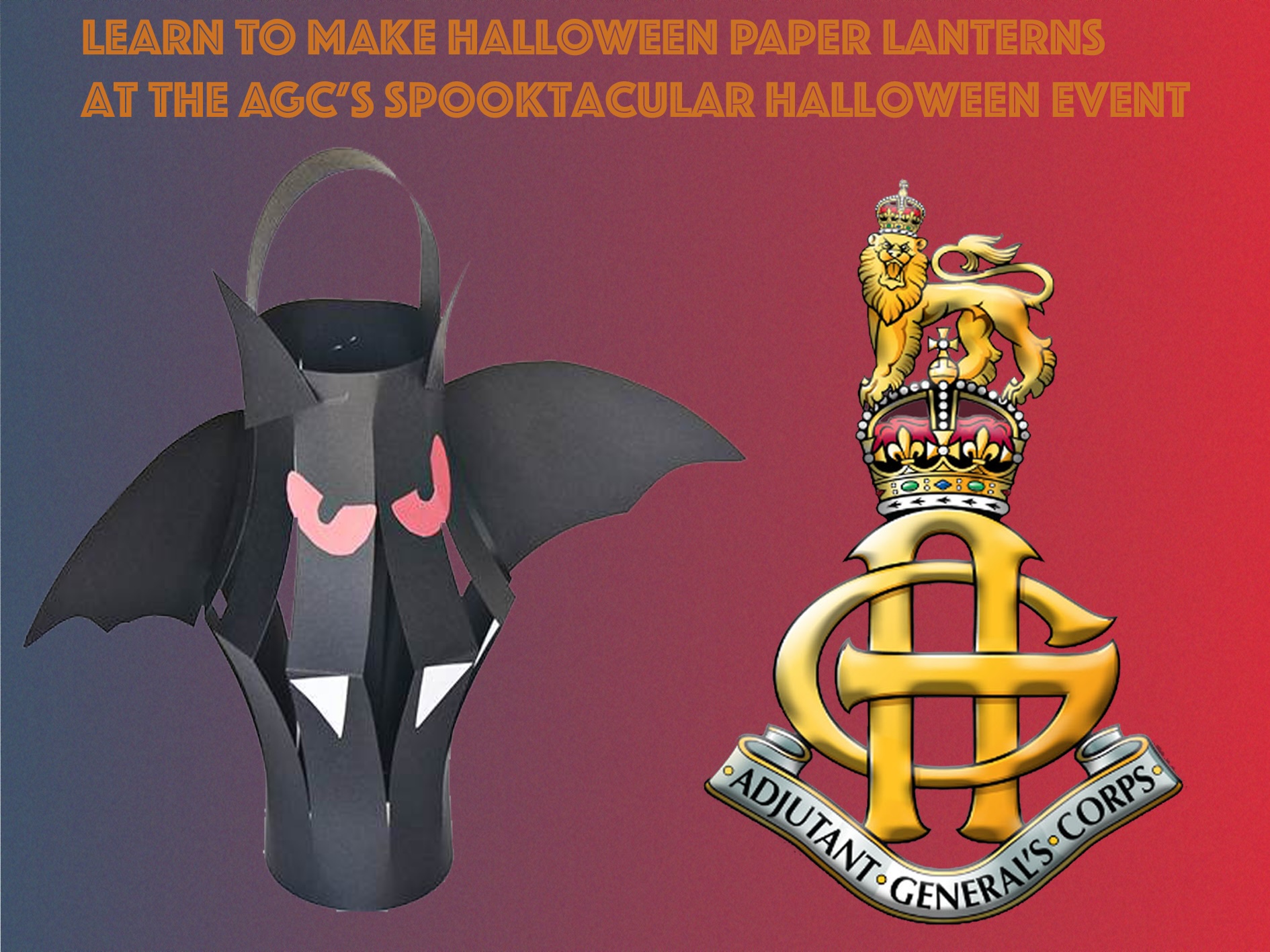
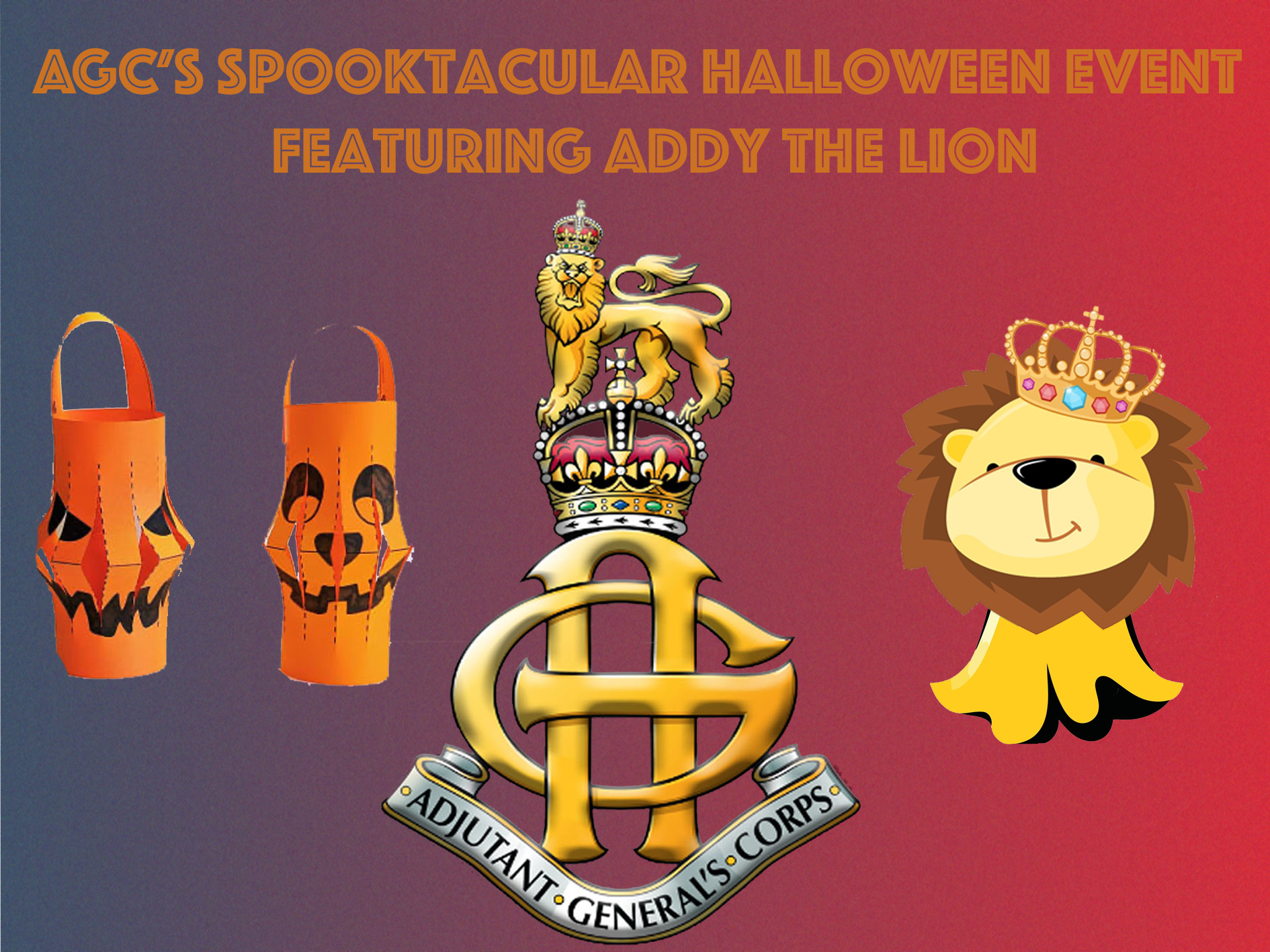
As part of my placement at the AGC Museum, I was tasked with creating social media posts to support advertising for the museum's events. The posts that I designed are all based around seasonal events such as Christmas and Halloween. These social media posts were created to attract customers and raise awareness of upcoming museum events.
Whilst reflecting on these posts, I saw there is room for improvement. I believe that having less writing in the posts themselves would be beneficial and look more appealing for the audience, as those words can be put in the post's captions instead, and more images in the post would also help, as the posts look quite bland with so little imagery in them, and more images could help to bring more life into the posts and help to make them overall more eye-catching and appealing for audiences.
From a sustainability perspective, all of these posts were created digitally rather than on paper, as excessive paper use would be wasteful and not in line with SDG12 (Responsible Consumption and Production). (The Global Goals, 2025b) They were all designed in Canva, as the AGC Museum recommended.
What I would have changed is getting the writing below the title; it could have been put in the caption instead, as it does not really suit the post and makes it look worse. The post would look better without that writing. I would have also added more Christmas elements to the post, as it seems rather plain with only the stocking and Addy the Lion. I would have added a Christmas tree in the background and more snowflakes to make the post more eye-catching for the audience and visually appealing.
Stakeholder feedback played an important role in the final design outcomes of these social media posts. During the early designs for these posts, the staff gave me feedback, such as there were not enough images or the font did not suit the posts. This feedback helped me revise my designs, change the font styles to something more appropriate, and add more visually appealing imagery to these posts, making them more appealing to audiences whilst also demonstrating effective stakeholder communication.
Figure 5: Background Designs.
Source: Author’s own work (Oliver Lund, 2025).
Here are some background designs: the second image was created in Photoshop, and the third in ChatGPT. These two designs were based on the AGC Museum's current background design. Their current design is the first image in the slideshow: the blue and red right-angled triangles. I designed the second background by changing the shapes from right-angled triangles to red and blue rectangles on each side. The third was created by ChatGPT, which merged the two colours to make the merged background. ChatGPT was used with permission of the AGC Museum.
AI was only used for one design, as overuse seemed unfair and unjust when doing placement work for the AGC Museum; they would always let me know when it was allowed and when it was not, and this was the only time it was allowed. The reason ChatGPT was used was that it was a tool available at the time, and I utilised it. This also helped with following the SDG12 goals, as overuse of ChatGPT can be detrimental to the environment due to its heavy water consumption (Yañez-Barnuevo, 2025), so its use was kept minimal. (See Appendix H)
I used Photoshop for my other design as it is a tool that I am very familiar with and felt appropriate for the work that had been put in front of me.
What I would have done differently for these backgrounds is come up with more original designs and create more designs. I would have liked to draft more ideas and sketch them to better understand how I want them to look, rather than using AI to generate backgrounds. This is something that I have learnt now and will incorporate better into my future work.
When doing all this work for the AGC Museum, you had to be aware of whom the promotional material was aimed at. The AGC Museum's target audience includes older people, visitors and families. Addy the Lion supports the family engagement by being appealing to the children of those families helping to influence parents' purchasing decisions. As noted by Kotler et al. (2008), segmentation is critical in museum marketing when creating promotional materials for different demographics. It discusses how demographic variables have long been the most popular for segmenting customer groups. In some instances, when designing for children, I make the design more straightforward and more visually appealing, using more colourful imagery and less text. When writing posts for older readers, aim to add more writing, since you are telling a story about the artefact you are showing them through the post, which is what they are typically interested in.
When writing this document, I compared their posts on Instagram and Facebook and explained how it seems inevitable that the Facebook posts perform better than the Instagram ones. I explained in the document that it would be wiser for the AGC Museum to post on their Facebook account more often to attract more attention from their audience and gain more likes, shares, and followers.
The post that did well told stories about the artefacts the museum had to offer, and that it was appealing to hear more about each artefact and its historical significance. I believe this to be due to the fact of the age of the audience, as the people in their age range, 60s to 80s, would typically come to the museum to look at the artefacts and learn more about them, so that is why the posts telling the stories of the artefact usually did so well on Facebook.
Towards the end of the document, there are many photos at the bottom; that would do well on their social media. The reason I chose these images in particular is that they are artefacts the museum owns, which I believe have interesting stories that will appeal to the audience and help the museum get the social media attention it wants. The document is available to download in the appendices. (See Appendix A)
During my placement, the AGC Museum was flexible but strict about AI use. AI tools such as ChatGPT were used only when permitted and appropriate; this further reflects the AGC Museum's decision to use traditional software instead. This could be due to concerns about sustainability and water consumption used for AI tools. (Yañez-Barnuevo, 2025)
Figure 6: Addy the Lion (The AGC Museum Mascot)
Source: Property of the AGC Museum (AGC Museum, 2025).
This is the original Addy the Lion design. Addy the Lion is the AGC Museum's mascot, and I used it as a reference when designing those notebooks. Character Brands such as Addy the Lion are commonly used for social media marketing. As stated by Keller (2012), this is done because characters such as these are good at grabbing the audience's attention and helping create brand awareness, and, if used right, they can stand out in the marketplace clutter, which helps the business stand out. The AGC Museum follows this idea to gain further recognition. When audience members see Addy the Lion, it instantly reminds them of the AGC Museum and helps attract more visitors. This also aligns with Phillips B's (1996) discussion of trade characters. He explains how mascots and character-based branding help organisations get recognised by audiences and connect with them, particularly in cultural and educational contexts.
Whilst doing all my work online, I did my best to follow sustainable practices and uphold the SDG 12 rules. Key examples of doing this include doing all the work online to prevent paper waste. Reusing some of the design materials as a way to save from having to use online resources to create new materials, and help to save the use of online resources, as using online resources can be damaging to the earth. An example of that is ChatGPT, which consumes a lot of water and electricity (Yañez-Barnuevo, 2025). While I was also doing my work, I found that a lot of energy was being conserved in the museum itself, such as not using any heating for the first few weeks of work. There was, however, a lot of energy being used elsewhere in the museum, such as everyone working on computers and keeping the lights on throughout the day. These were resources being used and violated the SDG 12 goals. These could have been fixed by them seeking more environmentally friendly ways to keep everything together, such as using energy-saving settings, reducing screen time and turning lights off at set times. (The Global Goals, 2025a)
Reflecting on my work practices during this placement, I highlighted the needs and wants related to SDG 12 (Responsible Consumption and Production). As someone who studies Graphic Design, there is a great temptation to gain access to significant additional assets, redesign ideas, and rely on new technology simply because it is readily available. However, as I progressed through my placement, I became aware that not all design decisions were necessary or even needed, and that overproduction/overuse, whether digital or physical, can play a significant role in unnecessary use.
When reflecting on my work practices in relation to SDG 12, a clear distinction emerged between wants and needs in my design practices. A practical example of this was my decision to limit my need for AI-generated content, such as ChatGPT, when creating my background designs. While AI tools were desired for their selflessness and convenience, they were not necessarily needed, and the design tasks could be done without them. By prioritising the use of established tools such as Photoshop and Canva, it reduced the need for ChatGPT whilst still maintaining good work. This decision further reflects responsible consumption by avoiding unnecessary energy- and water-intensive tools, demonstrating how design choices can align with SDG 12 goals.
One of these prime examples was when I did my background designs. At the same time, it would have been possible to continuously use ChatGPT to generate more designs for social media and branding. I decided to reuse and adapt my earlier designs to create new ones. This decision reduced unnecessary AI use and aligned with the SDG 12 goals.
My use of software also required some reflection. Although ChatGPT was available to use more often with permission, especially for designing more backgrounds, I made a conscious decision to limit my use of it. This was an ethical decision, as realising the harm AI causes to the environment through its water use helped influence my decision. By prioritising tools such as Photoshop and Canva, which I was already familiar with, this further reduced the need for AI and ensured that all designs were grounded. This helped me understand that efficiency does not equal sustainability, and that reducing unnecessary tool use can be a responsible design choice.
This placement has therefore become a significant influence on my future design practices. I am now more aware of what is sustainably viable, not only because of its environmental effects, but also of what software is unnecessary and of questioning whether a design choice actually adds any value. Moving forward, I will continue to acknowledge this reflective approach, use more appropriate design tools, reuse assets where appropriate, and evaluate my use of software tools as a designer. In doing so, I will adopt a more professional practice and align more closely with the goals to be more responsible and sustainable in my work.
In my findings of the AGC Museum, which plays a part in the tourism industry, I saw that many environmental factors come into play when trying to keep the museum running, such as the need to keep the lights on for the exhibits, having to keep the area well ventilated, and how they all use computers to do all of their work. All these aspects of the museum are very energy-consuming and are not suitable for the environment, but are essential as the museum will not be able to attract customers if the areas are not well ventilated and if their exhibits are not kept in a proper condition, so even though the tools that they use are not in line with the goals, they are necessary features.
The AGC Museum does play a key factor in the SDG 8 goals as it helps with economic growth through its use of attraction by having a free to visit entrance and relying on donations as this helps to attract more consumers and can help with attracting those consumers to see the other museums next door helping with the overall economic growth of all the museums in the Winchester area. (The Global Goals, 2025b)
When analysing the social media analytics for the AGC Museum's Instagram and Facebook using the Facebook Meta Suite, it becomes clear that their Facebook has a higher social media engagement than their Instagram. This is most likely because the museum's target audience is an older age group and because they primarily use Facebook. Even though Facebook was the more popular social media platform, these posts were ultimately posted on both Instagram and Facebook to reach as broad an audience as possible.
A key finding during my time at the AGC Museum was the difference between its two distinct demographics. For the Notebooks, they are clearly made for children; they are typically bought for the children by their parents, making the parents the target audience. Then when doing research into the AGC Museum's social media analytics I could clearly see which posts where doing better and how the posts that told stories about artefacts belonging to do well in the museum, were doing better on an old form of social media (Facebook) which made it clear that a lot of these posts were made with the understanding that their target is of an older age group (around 60-80).
During my placement, I developed skills in analysing social media performance for marketing research using the Facebook Meta Suite to identify which content drives engagement. I also further improved my abillities to design across multiple design tools such as Canva. While I am confident in my Photoshop skills, Canva helped further speed up my progress and make my work more suitable for the museum's needs. Overall, this placement has strengthened my skills with design tools and helped me learn to create audience-led designs.
Why these skills matter is because they help taught me how to use more than just one design app and with these new skills learnt through the app canva I can now use it to further help with my design work such as designing my posters for my research question essay or using it for the design of my social media posts in the future these are all valuable skills for my role as a designer.
The communication skills were a new skill that I had learnt at my placement, not communication in general, but communicating with a company was new for me. How I managed that was by going over all my work with people in the company.
Designing for children, a new audience for me, was a new experience, as I usually design for either my teachers or members of my class in an experiment. When designing for my audience, I learnt to make it simpler, as overcomplicating the design features to show off my design skills would not be beneficial for my new audience and would more than likely confuse them. The designs I made were as simple as possible, and I kept the Christmas theme to help appeal to my new younger audience.
When doing my own designs, I also had to learn how to balance my own creative ideas whilst also maintaining the brand's identity, which was a new skill that I had learnt, as all my previous work had been done for myself and not for a company, as designing for a company was overall a new experience for me. How I managed to maintain it was by constantly going over the work with the industry to help get reflective feedback and learn as to what more can be done for what I was designing and if it was up to the standards of what the business believes to be a proper social media post that helps maintain the brand identity and is considered appropriate for there social media. If I ever came up with a new idea, I would explain it to them, then design it to help them better understand it, and they would let me know how they felt about it.
My reliance on AI in the early stages was not necessary, but it helped me get a reasonable basis to work from and provided a clearer sense of where my work could be improved and how.
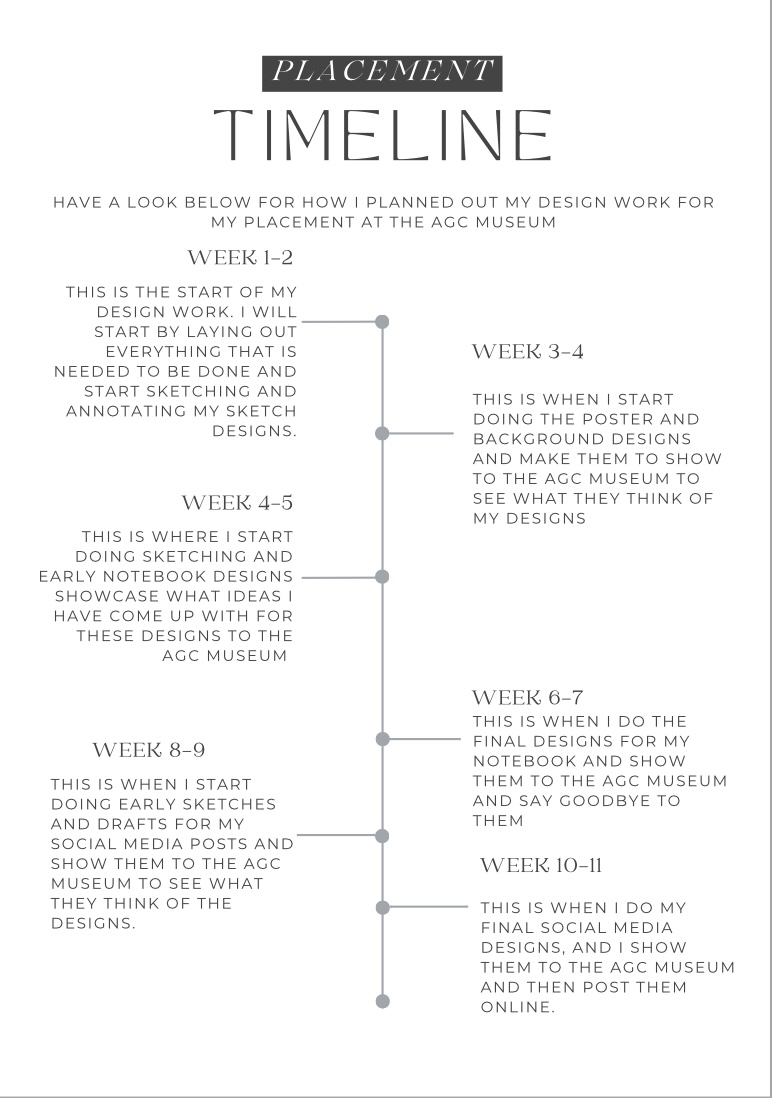
A timeline was created to help structure my placement and clarified what needed to be completed for each stage of design work. The timeline was divided into six sections of two-week periods, outlining what tasks needed to be done. This helped me to stay organised and manage my workload. (See Appendix B)
In conclusion, this work has taught me a lot and given me a broader understanding of what it is like to do design work for a company outside the university. This work has helped me learn to use apps such as Canva in ways I did not know before. I have learnt to develop further my skills, the importance of incorporating sketches into my work, and how they help build a brand.
This course has highlighted key areas for growth, such as time management, adaptability, and problem-solving. It has taught me to manage, balance, and control multiple tasks simultaneously for my work at the AGC Museum. It has taught me how to do so without seeming rushed or stressed. Learning all this has helped me develop my skills and has significantly improved my design process and work overall.
This placement has also helped reinforce reflective practice, demonstrating to me how continuous reflection helps make my work improve throughout development and further enhances what can be done. All that I have learnt will have a greater influence on my future design work as I put more of my newfound design skills into practice.
Black, G. (2012). Transforming Museums in the Twenty-first Century. 1st ed. [online] London. Available at:
https://www.taylorfrancis.com/reader/read-online/c6ee8e04-df3b-4296-9e9a-085b7898acc2/book/epub?context=ubx
[Accessed 16 Dec. 2025].
Cargo, R. and Cargo, E. (2001). Nonprofit Management and Leadership.[online] Wiley (John Wiley & Sons, Inc.). Available at:
https://onlinelibrary.wiley.com/doi/epdf/10.1002/nml.11408
[Accessed 2 Jan. 2026].
Falk, J. and Dierking, L. (2016). The Museum Experience Revisited. 1st ed. [online] New York. Available at:
https://www.taylorfrancis.com/reader/read-online/ffebdec8-9f48-4d16-b19d-56b685c6cbce/book/epub?context=ubx
[Accessed 23 Dec. 2025].
Kavaratzis, M. and Hatch, M.J. (2013). The dynamics of place brands: An identity-based approach to place branding theory.
Marketing Theory, [online] 13(1), pp.69–86. doi:
https://doi.org/10.1177/1470593112467268.
[Accessed 20 Dec. 2025]
Keller, K. (2012). Keller: Strategic Brand Management EBook GE 4e. 4th ed. [online] London: Pearson Education, Limited. Available at:
https://ebookcentral.proquest.com/lib/winchester/reader.action?docID=5173836&c=UERG&ppg=1
[Accessed 7 Jan. 2026].
Kotler, N., Kotler, P. and Kotler, W. (2008). Museum Marketing and Strategy: Designing Missions, Building Audiences, Generating Revenue and Resources.
[online] New Jersey: John Wiley & Sons. Available at:
https://books.google.co.uk/books?hl=en&lr=&id=DRUFCAAAQBAJ&oi=fnd&pg=PR13&dq=Museum+Marketing+and+Strategy:
[Accessed 2 Jan. 2026].
Phillips, B. (1996). Defining Trade Characters and Their Role in American Popular Culture. [online] Proquest.com. Available at:
https://www.proquest.com/docview/195360328?fromopenview=true&pq-origsite=gscholar&sourcetype=Scholarly%20Journals
[Accessed 5 Jan. 2026].
The Global Goals (2025a). Goal 12: Responsible consumption and production. [online] The Global Goals. Available at:
https://globalgoals.org/goals/12-responsible-consumption-and-production/
[Accessed 4 Jan. 2026].
The Global Goals (2025b). Goal 8: Decent Work and Economic Growth. [online] The Global Goals. Available at:
https://globalgoals.org/goals/8-decent-work-and-economic-growth/
[Accessed 11 Dec. 2025].
United Nations (2023). Sustainable tourism | Department of Economic and Social Affairs. [online] sdgs.un.org. Available at:
https://sdgs.un.org/topics/sustainable-tourism
[Accessed 20 Dec. 2025].
Yañez-Barnuevo, M. (2025). Data Centers and Water Consumption | Article | EESI. [online] Eesi.org. Available at: https://www.eesi.org/articles/view/data-centers-and-water-consumption [Accessed 11 Jan. 2026].
Black, G. (2012). Transforming Museums in the Twenty-first Century. 1st ed. [online] London. Available at:
https://www.taylorfrancis.com/reader/read-online/c6ee8e04-df3b-4296-9e9a-085b7898acc2/book/epub?context=ubx
[Accessed 16 Dec. 2025].
Cargo, R. and Cargo, E. (2001). Nonprofit Management and Leadership.[online] Wiley (John Wiley & Sons, Inc.). Available at:
https://onlinelibrary.wiley.com/doi/epdf/10.1002/nml.11408
[Accessed 2 Jan. 2026].
Falk, J. and Dierking, L. (2016). The Museum Experience Revisited. 1st ed. [online] New York. Available at:
https://www.taylorfrancis.com/reader/read-online/ffebdec8-9f48-4d16-b19d-56b685c6cbce/book/epub?context=ubx
[Accessed 23 Dec. 2025].
Kavaratzis, M. and Hatch, M.J. (2013). The dynamics of place brands: An identity-based approach to place branding theory.
Marketing Theory, [online] 13(1), pp.69–86. doi:
https://doi.org/10.1177/1470593112467268.
[Accessed 20 Dec. 2025]
Keller, K. (2012). Keller: Strategic Brand Management EBook GE 4e. 4th ed. [online] London: Pearson Education, Limited. Available at:
https://ebookcentral.proquest.com/lib/winchester/reader.action?docID=5173836&c=UERG&ppg=1
[Accessed 7 Jan. 2026].
Kotler, N., Kotler, P. and Kotler, W. (2008). Museum Marketing and Strategy: Designing Missions, Building Audiences, Generating Revenue and Resources.
[online] New Jersey: John Wiley & Sons. Available at:
https://books.google.co.uk/books?hl=en&lr=&id=DRUFCAAAQBAJ&oi=fnd&pg=PR13&dq=Museum+Marketing+and+Strategy:
[Accessed 2 Jan. 2026].
Kotler, P., Karatajaya, H. and Setiawan, I. (2017). Marketing 4.0 : Moving from Traditional to Digital.
[online] Hoboken, New Jersey: John Wiley & Sons (Wiley). Available at:
https://research.ebsco.com/c/evpzds/ebook-viewer/pdf/fktz6yxj3j?location=https%25253A%25252F%25252Fresearch.ebsco.com%
[Accessed 2 Jan. 2026].
Phillips, B. (1996). Defining Trade Characters and Their Role in American Popular Culture. [online] Proquest.com. Available at:
https://www.proquest.com/docview/195360328?fromopenview=true&pq-origsite=gscholar&sourcetype=Scholarly%20Journals
[Accessed 5 Jan. 2026].
The Global Goals (2025a). Goal 12: Responsible consumption and production. [online] The Global Goals. Available at:
https://globalgoals.org/goals/12-responsible-consumption-and-production/
[Accessed 4 Jan. 2026].
The Global Goals (2025b). Goal 8: Decent Work and Economic Growth. [online] The Global Goals. Available at:
https://globalgoals.org/goals/8-decent-work-and-economic-growth/
[Accessed 11 Dec. 2025].
United Nations (2023). Sustainable tourism | Department of Economic and Social Affairs. [online] sdgs.un.org. Available at:
https://sdgs.un.org/topics/sustainable-tourism
[Accessed 20 Dec. 2025].
Yañez-Barnuevo, M. (2025). Data Centers and Water Consumption | Article | EESI. [online] Eesi.org. Available at: https://www.eesi.org/articles/view/data-centers-and-water-consumption [Accessed 11 Jan. 2026].
Appendix A:
Appendix B:
Appendix C:
Here is a copy of the brand guidelines developed in Figma. This brand guideline helps discuss the typography, colour palette and
what kind of company the AGC Museum is. When viewing this, click the left or right side of the image to navigate through the brand guidelines.
Appendix D:
Appendix D1:
Appendix D2:
Above are my completed NLT forms, available for download.
Appendix E:
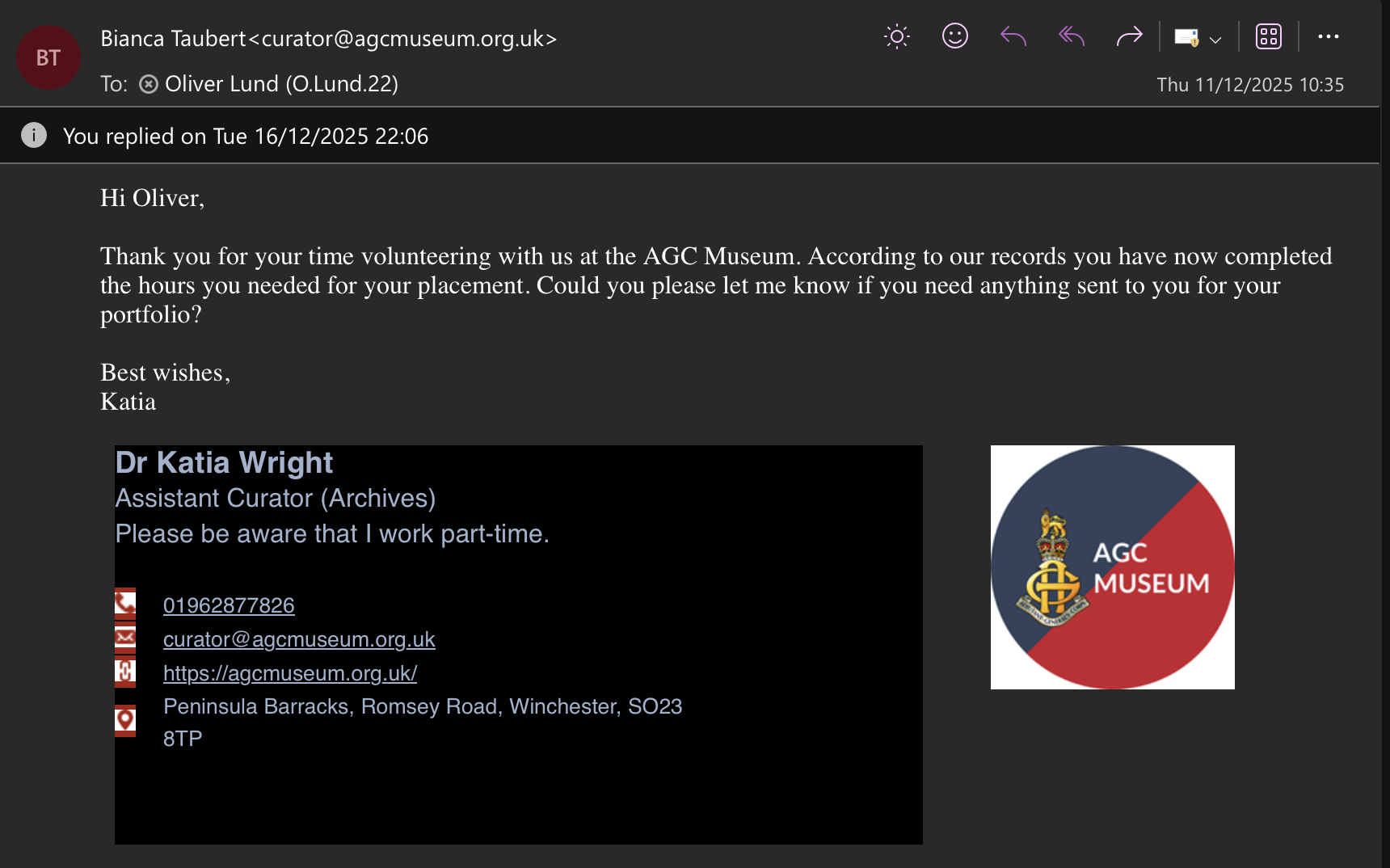
This is evidence that I completed my agreed placement terms. This email was sent by the AGC Museum, the company I worked for, confirming that I had finished my work. The Placement Learning Plan also shows the planned end date, further proving that I finished my placement and fulfilled my agreement.
Appendix F:
Here is the latest version of my CV, available for download.
Appendix G:
This work was assisted by Grammarly under my learning agreement and was approved for use by my teacher, Tina Scahill.
Appendix H:
Generative AI (ChatGPT) was used solely to create one background design, specifically the third background design shown on the background design slide, which merges two colours. This background was created during my placement in November 2025 with the permission of the AGC Museum. AI was not used to generate any written content, analysis, or evaluation for this report. All written work and design decisions are my own.
Literature Review
Methodology
Digital Analytics Review
Secondary Research and Literature
Sustainably-Led Design Approaches
Reflective Practices
Placement work
Sketches
Poster Design
Notebook Designs
Social Media Posts
Backgrounds
Audience
Instagram and Facebook
AI
The AGC Museum's Mascot
Sustainability Evaluation
SDG 12 Self-Reflection: Personal Needs, Wants and Design Responsibility
Findings and Analysis
Reflection
Reflection: Skills development and learning outcomes
Reflection: Critical reflections on challenges and limitations
Time Management
Conclusion
References
Bibliography
Appendices
Handover Documents
Brand Guidelines
NLT Forms
Placement Learning Plan
CV